"Battle-ready." It's printed on half the swords and axes on the internet, and it tells you almost nothing. There's no official standard, no test and no certificate. It's a marketing phrase, and it gets slapped on everything from properly heat-treated steel to things that would bend if you looked at them sternly.
So let's clear it up. This is the honest guide to the difference between a display replica and a functional (or "battle-ready") one, what to look for in each, and how to pick the right one for what you actually want to do with it.
The short version
- Display replicas are made to look right. They're for walls, stands and collections.
- Functional replicas are made to be used: cutting, chopping and handling. The steel, the heat treatment and the construction all have to be up to it.
- Reenactment and sparring blades are a third category altogether: deliberately blunt, and built to hit other blades safely.
None of these is "better". They're for different jobs, and the best one is the one that matches yours.
What is a display replica?
A display replica prioritises looks. It might be a movie or game sword recreated down to the last detail, or a historical piece made to show off rather than swing. Common traits:
- Stainless steel. Usually a grade like 420 or 440. It resists rust and polishes beautifully, which is perfect for the wall. But in long blades, stainless steel is generally more brittle than a good carbon steel under hard impact.
- A thinner, "rat-tail" tang. The tang is the part of the blade that runs into the handle. On many display pieces, it's a narrow rod welded or threaded on, which is fine for hanging but not for hitting.
- Unsharpened edges, or a light edge for looks.
- Detail over durability. Cast fittings, intricate guards and fine decoration that you really don't want to bash into anything.
A great display piece is still a thing of beauty. If you want a centrepiece for a collection, it's often exactly the right choice.
What makes a replica "battle-ready" or functional?
A functional blade is built around how it performs, not just how it looks. The things that matter:
Carbon steel, properly heat treated
Most functional swords and axes use high carbon steel, with grades like 1060 and 1095, or spring steels like 5160. The steel alone isn't enough, though: it has to be heat treated (hardened and then tempered) so it's hard enough to hold an edge but tough enough to flex and not snap. That heat treatment is the single biggest difference between a real blade and a steel-shaped object.
A full tang
On a functional sword, the tang should be a substantial continuation of the blade itself, running the length of the grip and secured at the pommel. Our Full Tang Bearded Axe takes the same idea to an axe: one piece of high carbon steel from blade to butt, so there's no head to work loose.
A real edge
Functional blades usually come sharp, or can be sharpened. That's the point, but it also means you need to treat them with respect.
The trade-off: care
High carbon steel rusts if you neglect it. Dry it after use and give it a light coat of oil, and it'll last a lifetime. Our Blade Care 101 guide covers everything.
A real example: the Pizza Axe
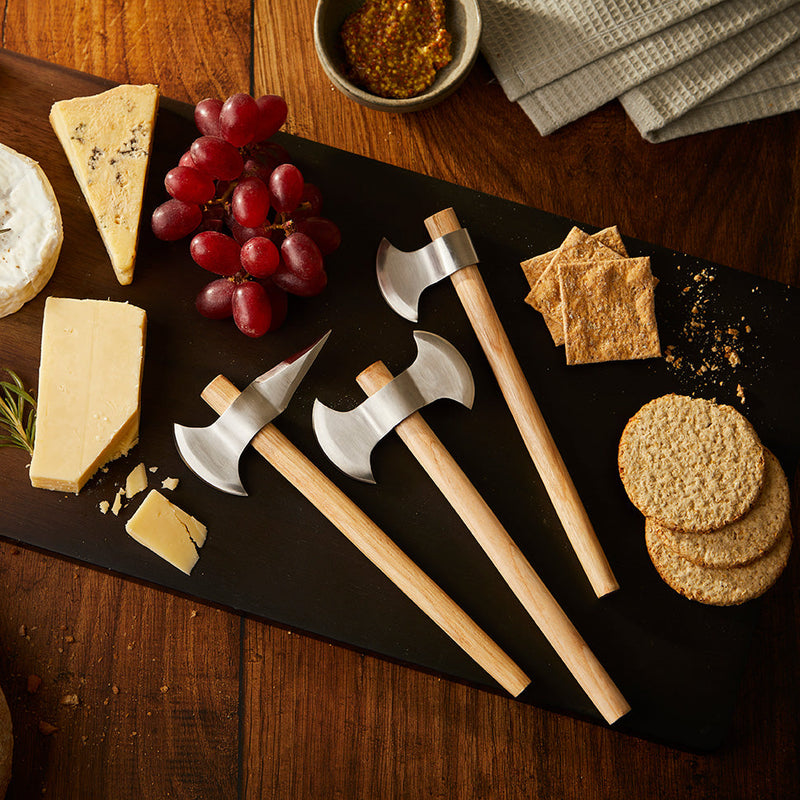
Our own Pizza Axe is a nice example of these trade-offs in action. The first run in 2020 had a high carbon steel blade, which takes a superb edge but needs looking after. In a kitchen, where things get wet and washed, that was hard work. Based on customer feedback, we moved it to 440 stainless steel, which is far more kitchen-friendly and easier to keep in top condition. That's the right steel for that job, even though it isn't what we'd choose for a chopping axe.
What about reenactment and sparring?
If you want to fight with it, even in a controlled way, you don't want a sharp blade at all. Reenactment groups and HEMA (Historical European Martial Arts) clubs use blunts and trainers with thick, rounded edges and safe tips, and most societies have their own weapon standards and safety checks. Always check with your group before you buy. A sharp "battle-ready" sword is the wrong tool for sparring, however good it is.
So which should you buy?
- For your wall or collection: a display or licensed replica, chosen for accuracy and detail.
- For chopping and practical use: a functional axe in forged high carbon steel. Most of our Viking axes are exactly that, and The Ragnar is a proper wood-chopping companion.
- For throwing: an axe balanced for it. Browse our throwing axes.
- For reenactment or sparring: a blunt made to your group's rules.
- For a gift: think about what they'll actually do with it. If in doubt, display pieces and licensed replicas are the safest bet, and they're the ones that get shown off.
Whatever you're looking at on our site, the listing tells you the materials, the edge and the dimensions, so you know exactly what you're getting.
A word on licensed replicas and knock-offs
Movie and game swords are where knock-offs are most common. If a famous sword is on sale for a fraction of the usual price with no licence mentioned, it's almost certainly a fake, and the quality usually matches the price. Officially licensed replicas are approved by the people who own the franchise, so the design is accurate and the quality is checked.
Our own Legends Collection is designed in-house and officially licensed. That includes Geralt of Rivia's swords, made in collaboration with CD PROJEKT RED, and our Assassin's Creed sword replicas. We built the Sword of Altaïr, for example, from more than 200 references and drew on our own sword-fighting background so it looks right and feels right in the hand.
Battle-ready vs display: FAQs
Is "battle-ready" a real standard?
No. It's a marketing term with no official definition. Look at the steel, the heat treatment, the tang and the edge instead.
Can I sharpen a display sword?
Sometimes, but it won't make it functional. If the steel, heat treatment and tang weren't built for use, a sharp edge just makes it a sharp display piece.
Is stainless steel bad for swords?
Not at all for display, kitchen tools or small blades. For long blades that will take hard impacts, a well heat-treated carbon steel is generally tougher.
Do I need to be 18 to buy one?
Yes. In the UK you must be 18 or over to buy bladed items, and we ship with age verification as standard.